The previous post on this topic had worked on the assumption that there was only one civilization spreading throughout a galaxy. But Forge of God and it's sequel went further with the idea by including other possible civilizations too.
So let's take a look at the implications. As planetisms spread out into the galaxy they'll encounter exo-planetisms with different forms of life and civilization.
The possibility here is for further evolution of one or more planetisms, either via cooperation, parasitism or competition. In essence it's the creation of a galactic scale ecology which, if it can stabilize, becomes a galactism.
Just as a planetism is a planet-spanning organism a la Gaia, a galactism is a galaxy-spanning organism with very large scale "metabolisms" and homeostasis. The size of a galactism would in fact be so vast that (assuming no faster-than-light travel is possible) its equivalent of breathing or a heartbeat would last on the order of a few hundred-thousand years to millions of years.
A topic like this is rather big and has a lot of ground for speculation, with that said the post ends here but I might return to these ideas in future posts.
Showing posts with label The Future. Show all posts
Showing posts with label The Future. Show all posts
Thursday, September 20, 2018

Friday, August 31, 2018
Apes or Termites
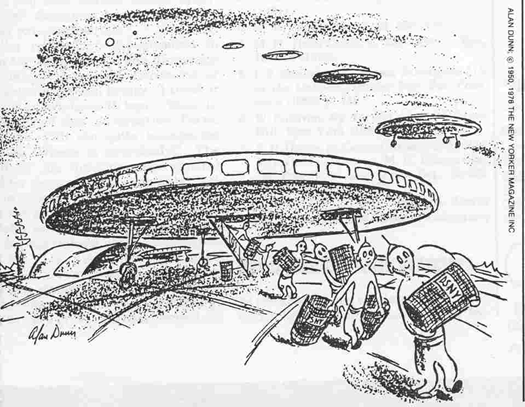
It's the year 1950 and a group of scientists are on their lunch break at Los Alamos National Laboratory. The scientists are discussing aliens tongue-in-cheek -partly due to a New Yorker comic- when one of the scientists asks a question: "Where are they?" The scientist who asked that question was the Italian physicist Enrico Fermi, and his question haunts many to this day.
There are hundreds of billions of stars in our galaxy, some a good deal older than our sun, and most stars probably also have planets around them. So you'd expect that there would be at least one civilization far in advance of us out there, but evidence of such is lacking. So the question "where are they?" remains stubbornly unanswered.
I've been interested in Fermi's paradox (the name this problem has) for a number of years now. I'm not going to list ideas on this post but rather focus on a particular solution which briefly appears in the Stephen Baxter novel Manifold: Space.
Upon seeing the activities of an alien species, character Reid Malenfant remarks on how they resemble termites in a colony. Reid then speculates that most space-faring aliens will probably be cooperative (termites), rather than competitive (apes, or humans) in nature.
Think about what it means to be "ape" in nature. Much of our competitive spirit goes towards activities that are often destructive. Demanding bigger and more wasteful houses to keep up with the Joneses, building more nuclear weapons and placing them ever closer to an antagonistic country as a form of chest-beating, maximizing profit by lobbying against environmental protections, etc.
It stands to reason that a species that is "termite" in nature would be less likely to destroy itself in this way. Instead of carbon belching to "stick it to the libs" when resources are running low, members of the species would probably just consume less. The idea of nationalism would make no sense to them because it's anathema to cooperation. You see what I'm getting at.
Perhaps the truly long lived civilizations in the form of these "termites" simply don't need to explosively spread out into space. They might only deign to leave their planet when their home system is due for destruction, and then only stick to one colonizable body in a new system rather than exploiting every astronomical body in it.
I sincerely hope that this isn't the answer, it bodes quite poorly for our civilization if it is.
Monday, July 30, 2018
Exit Planet Transhuman?

Perhaps some of the readers here have heard of the death of John Perry Barlow. If the name doesn't ring a bell, he wrote something called "A Declaration of the Independence of Cyberspace", the Libertarian manifesto that lead to the currents in modern day Silicon Valley of "disruption" and "move fast and break things". You know, stuff that "disrupted" people's privacy and "broke" civil discourse.
One of the most incredible things about this man though is that he believed in the techno-libertarian dream to the end of his life, even as it ravaged the very medium he had fawned over.
A recent Verge article quoted the Electronic Frontier Foundation staff member Cindy Cohn: "Barlow knew that new technology could create and empower evil as much as it could create and empower good. He made a conscious decision to focus on the latter.”
"Focus on the latter", think about that prase. It's a rather vague phrase but I get the feeling from it that Barlow had decided to shut out the very thought that the web could be used for evil, or at the very least stubbornly refused to rethink his ideology as it came crashing down upon the world.
There's a word for that: willful ignorance. And it seems that some of the big-hitters of the transhumanist movement continue that legacy of willful ignorance.
An older article by Vice gives a look into the thought processes of a well known transhumanist named Zoltan Istvan. A member of a group of transhumanists floated the possibility of inequality persisting into the future.
Most of the members of the group agreed with her, but Zoltan's response was: 'The good news is that we don't have the robber barons of the 20th century ... We don't have child labor and stuff like that in America anymore, we have a lot of better rules, and I know it's not perfect but it's very hard for the Bill Gates or the Mark Zuckerberg to do anything that is so against the people ... There's no question that within the next three to five years something like the Transhumanist Bill of Rights is going to enter into the United Nations Declaration of Human Rights," he said. He did not think that government or corporations would play a role'.
There's a major bit of handwaving here: "He did not think that government or corporations would play a role". It doesn't seem to occur to him that the lack of modern robber barons and child labor (in the U.S. at least) resulted from government action, not in spite of it.
In fact he seems to ignore the fact that "the government" is employed by groups of individual people in representative democracies. Yes, there are loopholes and wealth inequality itself that small groups can take advantage of to sway democratic governments, but the heart of the idea is still sound (as evidenced -again- by the lack of robber barons and child laborers in the modern U.S.). No man is an island.
But this thought that "if we just throw more technology at everything and ignore pesky things like politics and social sciences then everything will be okay!" strikes me as a big damn problem in the transhumanist movement.
So maybe it's time to leave transhumanism behind.
It was an interesting prototype, but it's time to make something that factors in a broader view of the world and people (big hint: nobody -and this applies to Libertarians too- are ultra-rational in unregulated capitalism).
We can't stay in this cradle called transhumanism forever.
Sunday, June 3, 2018
Morphological freedom? But I thought...
I find it odd that the transhumanist movement as of late seems to be filled with people who hate "SJWs" -which is usually shorthand for non-binary genders.
But I'm stumped as to why this kind of thinking is a thing to begin with in the transhumanist movement. A major -if not the core- ideal of transhumanism is the transcendence of the body, mind and spirit (however the later is defined) beyond current limitations of biology, including sexuality and gender.
So the idea of non-binary gender models is absolutely something that meshes perfectly with transhumanism. However, it seems that the practitioners of transhumanism themselves have discarded the full exploration of that idea in favor of fantasizing about indestructible Terminator bodies (Schwarzenegger-style disguise optional), and Vinge forbid there be something outside of the black-and-white dichotomy.
But I'm stumped as to why this kind of thinking is a thing to begin with in the transhumanist movement. A major -if not the core- ideal of transhumanism is the transcendence of the body, mind and spirit (however the later is defined) beyond current limitations of biology, including sexuality and gender.
So the idea of non-binary gender models is absolutely something that meshes perfectly with transhumanism. However, it seems that the practitioners of transhumanism themselves have discarded the full exploration of that idea in favor of fantasizing about indestructible Terminator bodies (Schwarzenegger-style disguise optional), and Vinge forbid there be something outside of the black-and-white dichotomy.
Wednesday, May 23, 2018
The Alchemist
Years ago, in an introductory study of religion class our teacher had presented an image to the class.

The image above was painted by the 19th century artist Caspar David Friedrich and was entitled Wanderer above the Sea of Fog.
While the image is often associated with German Romanticism there was a different interpretation of the image: the societal shock after the Second World War with the interpretation itself being akin to this:
-------------------------------------------------
We thought that scientific and technological progress alone would bring about a utopia, but instead the pinnacle of our achievements led to continent-scale warfare, genocide orders of magnitude greater in scope and totality than any previous age and the specter of nuclear war. In the painting the hiker has scaled a mountain... but there's nothing there. And now civilization has scaled incredible peaks in scientific understanding and technological ability but have found its reality falling far short of its promise.
So... now what?
------------------------------------------------
Of note: the interpretation above can be only very slightly re-worded and describe the current state of civilization as well.
We've wired up the world, connected everyone to everyone, have both made and are making great strides in the fields of computers, biological sciences (both pure and applied) and global connectivity. We thought (some still think) that science and technology alone can save us from all of our problems. But the promised utopia of a smarter, better educated and less militaristic humanity never arrived. We forgot the human element when chasing fantasies of a perfect future and now we find ourselves facing a resurgence of militant nationalism, ignorance, distrust and hatred.
So... now what?
I belive this passage from Green Mars by Kim Stanley Robinson might hold part of an answer:
While I'm not sure mysticism is what should be aimed for, there is another ideal we could embrace, and indeed I have already alluded to it in this post: the human element.
I'm not trying to make an appeal to nature but instead the understanding that the human element is just as important in factoring into the trajectory of our collective future than technology on its own.
Why not see the good in humanity, cherish the goodness and nurture it wherever we go? Should we not all strive to be the Alchemist?

The image above was painted by the 19th century artist Caspar David Friedrich and was entitled Wanderer above the Sea of Fog.
While the image is often associated with German Romanticism there was a different interpretation of the image: the societal shock after the Second World War with the interpretation itself being akin to this:
-------------------------------------------------
We thought that scientific and technological progress alone would bring about a utopia, but instead the pinnacle of our achievements led to continent-scale warfare, genocide orders of magnitude greater in scope and totality than any previous age and the specter of nuclear war. In the painting the hiker has scaled a mountain... but there's nothing there. And now civilization has scaled incredible peaks in scientific understanding and technological ability but have found its reality falling far short of its promise.
So... now what?
------------------------------------------------
Of note: the interpretation above can be only very slightly re-worded and describe the current state of civilization as well.
We've wired up the world, connected everyone to everyone, have both made and are making great strides in the fields of computers, biological sciences (both pure and applied) and global connectivity. We thought (some still think) that science and technology alone can save us from all of our problems. But the promised utopia of a smarter, better educated and less militaristic humanity never arrived. We forgot the human element when chasing fantasies of a perfect future and now we find ourselves facing a resurgence of militant nationalism, ignorance, distrust and hatred.
So... now what?
I belive this passage from Green Mars by Kim Stanley Robinson might hold part of an answer:
"Very good Nirgal. Your sight has such insight. In archetypal terminologies we might call green and white the Mystic and the Scientist. Both extremely powerful figures, as you see. But what we need, if you ask me, is a combination of the two, which we call the Alchemist."
While I'm not sure mysticism is what should be aimed for, there is another ideal we could embrace, and indeed I have already alluded to it in this post: the human element.
I'm not trying to make an appeal to nature but instead the understanding that the human element is just as important in factoring into the trajectory of our collective future than technology on its own.
Why not see the good in humanity, cherish the goodness and nurture it wherever we go? Should we not all strive to be the Alchemist?
Subscribe to:
Posts (Atom)